Once upon a twinkling night in the cozy town of Willow Creek, there lived a bright and cheerful 8-year-old girl named Callie, who went to Maplewood Elementary. Callie was known for zipping through her homework faster than a shooting star, always finishing her math problems and spelling words before the sun dipped below the horizon. Her laughter echoed through the playground, and her kindness made her the most popular girl in third grade. Everyone wanted to sit with her at lunch or join her for games of tag.
But there was one boy, Dylan, who wasn’t so lucky. Dylan was quiet, a little quirky, and often tripped over his own feet during kickball, which made some kids giggle. He wasn’t popular like Callie, but she didn’t care. Callie saw the good in everyone, and she’d always wave to Dylan or share her crayons when he forgot his. “Everyone deserves a friend,” she’d say with a smile.
Lately, though, things had changed. Whispers started spreading around Maplewood Elementary like dandelion seeds in the wind. Kids said Dylan was annoying, always making up wild stories—like how he’d seen a dragon in his backyard or caught a fish as big as a bicycle. At first, Callie laughed off the tales, thinking Dylan just had a big imagination. But soon, the other kids stopped inviting him to play, and they’d roll their eyes whenever he spoke. “He’s lying again,” they’d groan. Callie felt a tug in her heart. She didn’t like how everyone was turning on Dylan, but she also wondered: Was he telling the truth, or was something else going on?
Determined to find out, Callie turned into a detective, her ponytail bouncing as she snooped around the school. She called it “The Mystery of Dylan’s Stories.” During recess, she watched him closely. When Dylan told a group of kids he’d found a secret treasure map in the library, Callie decided to investigate. She marched to the library after school, her sneakers squeaking on the polished floor, and asked Mrs. Linden, the librarian, if there were any treasure maps hidden in the books. Mrs. Linden chuckled and shook her head. “No maps here, Callie, just stories and imagination.”
The next day, Dylan swore he’d seen a talking owl outside his window. Callie, with her detective notebook in hand, asked her neighbor, Mr. Jenkins, who knew all about birds. “A talking owl?” he said, scratching his head. “Owls hoot, but they don’t chat, dear.” Callie’s suspicions grew. She didn’t want to believe Dylan was lying, but the clues were piling up.
One sunny afternoon, Callie sat with Dylan under the big oak tree on the playground. “Dylan,” she said gently, “why do you tell these stories? Like the dragon and the treasure map?” Dylan’s cheeks turned red, and he looked at his sneakers. “I just… want people to like me,” he mumbled. “If I tell cool stories, maybe they’ll think I’m cool, too.”
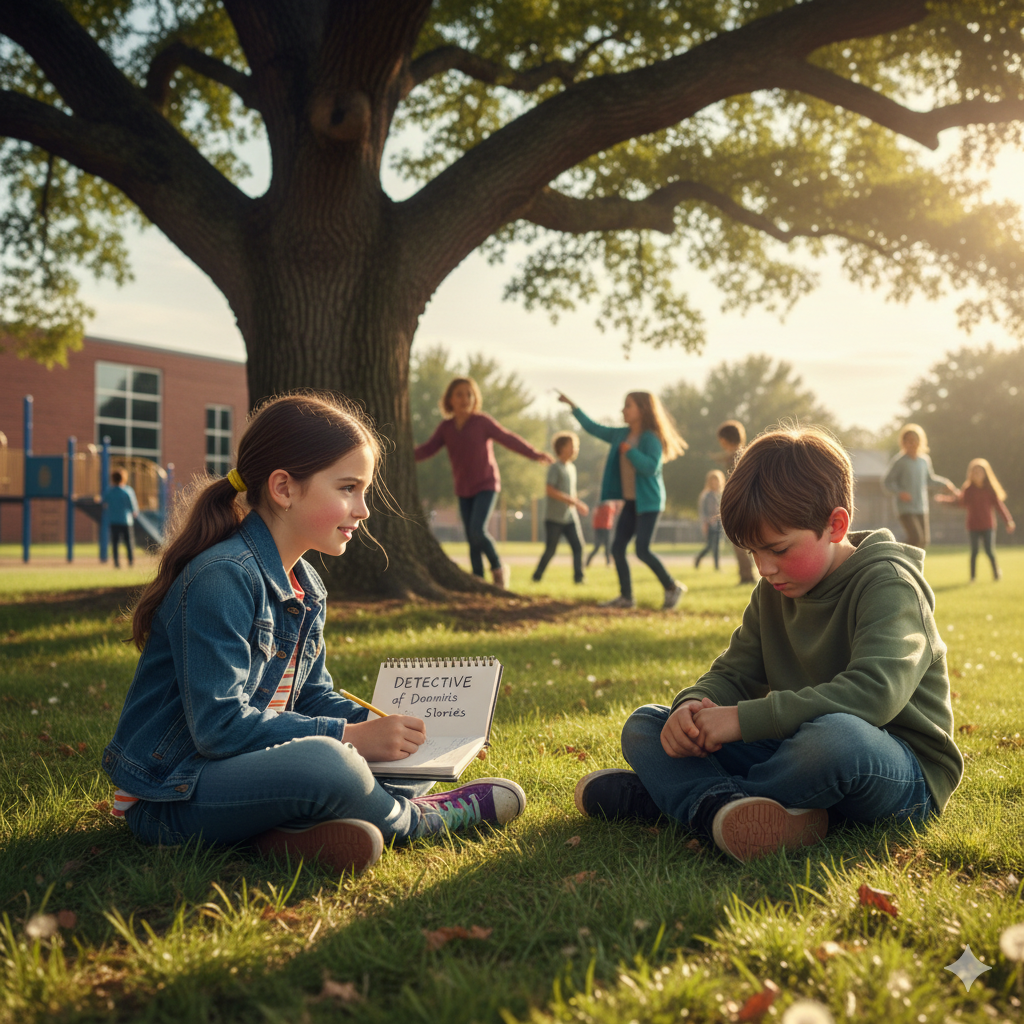
Callie’s heart sank. She understood wanting to fit in, but lying wasn’t the way. “You don’t need to make things up,” she said. “People will like you for who you are, not for fake stories.” But Dylan shook his head. “It’s too late. Nobody likes me now anyway.” He got up and walked away, leaving Callie with a heavy feeling.
Over the next few days, Dylan kept telling his tall tales, and the other kids grew even meaner, whispering and laughing behind his back. Callie tried to talk to him again, but he wouldn’t listen. She realized that, even though she cared about him, she couldn’t be friends with someone who wasn’t honest. It made her sad, but she knew trust was important. She stopped sitting with Dylan at lunch, and soon, they weren’t friends anymore.
Callie learned a big lesson that year at Maplewood Elementary: being kind doesn’t mean ignoring the truth. She still smiled at everyone, still shared her crayons, and still zoomed through her homework. But she also learned to listen to her heart and stand up for what was right, even when it was hard. And as she drifted off to sleep each night, she dreamed of new mysteries to solve, knowing she’d always try to be fair and true.
The end. Goodnight, sweet dreamer.